
See Touch Learn
This app is about recognizing different things such as apples, what picture can you see, or which animal says woof woof. And they have different lessons. It starts with easy and gets harder each lesson.
How I can use this in my future classroom? When I teach a classroom and I want them to be able to recognize certain things. This is a great way for the students to recognize certain things. So I could get them to gather around and play a game with them.
Thursday, December 6, 2012

App assignment #1
Sight Words 2
This app is about how to spell different words. They display the words and then the app talks and spells out the word.
I could use this in my future classroom because if I want to teach a lesson on how to spell words. I could let the students gather around the ipad and we could do an activity with sight words 2 to teach them how to spell words.
This app is about how to spell different words. They display the words and then the app talks and spells out the word.
I could use this in my future classroom because if I want to teach a lesson on how to spell words. I could let the students gather around the ipad and we could do an activity with sight words 2 to teach them how to spell words.
Wednesday, December 5, 2012
Wednesday, November 28, 2012
Monday, November 12, 2012
Three changes to Web Quest
The
three changes I would make to this webquest would be on the task page i
would of not linked the questionnaire quite yet. I would of waited to
do that on the process page. The reptiles and the amphibians links all
the pictures are broken so how are the students going to pick one.
Web Quest Rubric
|
|
|
|
|
||
|
Overall
Aesthetics (This
refers to the WebQuest page itself, not the external resources linked
to it.) |
|||||
|
Overall
Visual Appeal
|
0 points There are few or no graphic elements. No variation in layout or typography. OR Color is garish and/or typographic variations are overused and legibility suffers. Background interferes with the readability. |
2 points Graphic elements sometimes, but not always, contribute to the understanding of concepts, ideas and relationships. There is some variation in type size, color, and layout. |
4 points Appropriate and thematic graphic elements are used to make visual connections that contribute to the understanding of concepts, ideas and relationships. Differences in type size and/or color are used well and consistently. See Fine Points Checklist. |
4 points There is pictures in here but they are on links but great pictures. |
|
|
Navigation
& Flow
|
0 points Getting through the lesson is confusing and unconventional. Pages can't be found easily and/or the way back isn't clear. |
2 points There are a few places where the learner can get lost and not know where to go next. |
4 points Navigation is seamless. It is always clear to the learner what all the pieces are and how to get to them. |
4 points the places where the students need to go is linked and in a different color. | |
|
Mechanical
Aspects
|
0 points There are more than 5 broken links, misplaced or missing images, badly sized tables, misspellings and/or grammatical errors. |
1 point There are some broken links, misplaced or missing images, badly sized tables, misspellings and/or grammatical errors. |
2 points No mechanical problems noted. See Fine Points Checklist. |
1 point when you go on the links some of the pictures you can't see. | |
|
Introduction |
|||||
|
Motivational
Effectiveness of Introduction
|
0 points The introduction is purely factual, with no appeal to relevance or social importance OR The scenario posed is transparently bogus and doesn't respect the media literacy of today's learners. |
1 point The introduction relates somewhat to the learner's interests and/or describes a compelling question or problem. |
2 points The introduction draws the reader into the lesson by relating to the learner's interests or goals and/or engagingly describing a compelling question or problem. |
2 points for the age group the intro really gets the readers attention. |
|
|
Cognitive
Effectiveness of the Introduction
|
0 points The introduction doesn't prepare the reader for what is to come, or build on what the learner already knows. |
1 point The introduction makes some reference to learner's prior knowledge and previews to some extent what the lesson is about. |
2 points The introduction builds on learner's prior knowledge and effectively prepares the learner by foreshadowing what the lesson is about. |
2 points in the intro they tell you about what the activity is about and what they are going to do. |
|
|
Task
(The task is
the end result of student efforts... not the steps involved in getting
there.) |
|||||
|
Connection
of Task to Standards
|
0 points The task is not related to standards. |
2 point The task is referenced to standards but is not clearly connected to what students must know and be able to do to achieve proficiency of those standards. |
4 points The task is referenced to standards and is clearly connected to what students must know and be able to do to achieve proficiency of those standards. |
4 points in this webquest they don't go off subject they stay on subject. |
|
|
Cognitive
Level of the Task
|
0 points Task requires simply comprehending or retelling of information found on web pages and answering factual questions. |
3 points Task is doable but is limited in its significance to students' lives. The task requires analysis of information and/or putting together information from several sources. |
6 points Task is doable and engaging, and elicits thinking that goes beyond rote comprehension. The task requires synthesis of multiple sources of information, and/or taking a position, and/or going beyond the data given and making a generalization or creative product. See WebQuest Taskonomy. |
6 points The task is deffinetly doable, and it goes beyond the webquest. | |
|
Process
(The process
is the step-by-step description of how students will accomplish the task.) |
|||||
|
Clarity
of Process
|
0 points Process is not clearly stated. Students would not know exactly what they were supposed to do just from reading this. |
2 points Some directions are given, but there is missing information. Students might be confused. |
4 points Every step is clearly stated. Most students would know exactly where they are at each step of the process and know what to do next. |
4 points the instructions are very clear. |
|
|
Scaffolding
of Process
|
0 points The process lacks strategies and organizational tools needed for students to gain the knowledge needed to complete the task. Activities are of little significance to one another and/or to the accomplishment of the task. |
3 points Strategies and organizational tools embedded in the process are insufficient to ensure that all students will gain the knowledge needed to complete the task. Some of the activities do not relate specifically to the accomplishment of the task. |
6 points The process provides students coming in at different entry levels with strategies and organizational tools to access and gain the knowledge needed to complete the task. Activities are clearly related and designed to take the students from basic knowledge to higher level thinking. Checks for understanding are built in to assess whether students are getting it. See: |
6 points The students will learn different strategies in finding out what the animal is and etc. They do not go off topic at all. |
|
|
Richness
of Process
|
0 points Few steps, no separate roles assigned. |
1 points Some separate tasks or roles assigned. More complex activities required. |
2 points Different roles are assigned to help students understand different perspectives and/or share responsibility in accomplishing the task. |
2 points There is separate roles one students from each group could do a different questionnaire. |
|
|
Resources
(Note: you should
evaluate all resources linked to the page, even if they are in sections
other than the Process block. Also note that books, video and other off-line
resources can and should be used where appropriate.) |
|||||
|
Relevance
& Quantity of Resources
|
0 points Resources provided are not sufficient for students to accomplish the task. OR There are too many resources for learners to look at in a reasonable time. |
2 point There is some connection between the resources and the information needed for students to accomplish the task. Some resources don't add anything new. |
4 points There is a clear and meaningful connection between all the resources and the information needed for students to accomplish the task. Every resource carries its weight. |
4 points There is a clear connection it stays on topic. |
|
|
Quality
of
Resources |
0 points Links are mundane. They lead to information that could be found in a classroom encyclopedia. |
2 points Some links carry information not ordinarily found in a classroom. |
4 points Links make excellent use of the Web's timeliness and colorfulness. Varied resources provide enough meaningful information for students to think deeply. |
2 points some of the links are broken so you can't get the information. |
|
|
Evaluation |
|||||
|
Clarity
of Evaluation Criteria
|
0 points Criteria for success are not described. |
3 points Criteria for success are at least partially described. |
6 points Criteria for success are clearly stated in the form of a rubric. Criteria include qualitative as well as quantitative descriptors. The evaluation instrument clearly measures what students must know and be able to do to accomplish the task. See Creating a Rubric. |
6 points the criteria is clearly states. They give really good instructions they children would understand it clearly. |
|
|
Total
Score |
47/50
|
||||
Friday, November 9, 2012
Wednesday, November 7, 2012
Double Entry Journal #15
1. What is the purpose of this chapter?
How students, who are so clearly familiar and apparently adept with internet tools, are at times so poor at using the internet academically.
2. What is the major finding from a review of studies that have looked at technology adoption of young people? Does this finding seem to reflect your own use of technology?
When young people use the internet its to look at information they want to look at or watch a video or a movie. But when asked to use it for a class project or something they don't want to do it because they are not interested in the subject.
3.How do the authors define information literacy?
Eisenberg defines information literacy as the set of skills and knowledge that allows us to find, evaluate, and use the information we need as well as to filter out the information we don't need.
4. What is the "clear message" from a review of the studies focused on college students information seeking behavior? Do these findings reflect your own information seeking behaviors?
While students are often strategic and efficient information seekers within the digital landscape, they can also express frustration and impatience in their own searching abilities and skills.
5. What does the term "satisfacing" in the area of decision making mean?
One that is acceptable to an individual based on some personal criterion but it is a decision or course of action that is known not to be the best one.
6. What are the differences to deep and surface level approaches to a learning task?
Students who adopted a deep approach to the learning task were inclined to focus on trying to comprehend the meaning behind learning material. Surface approach to the learning task tended to focus on simply reproducing what was contained within the learning material with little concern for understanding the overall meaning.
7. What should educators aim to do to improve the scripts student have for sophisticated online information seeking?
They should aim to improve technology by giving them certain websites to go to. And don't let them take their homework outside of class schedule in class homework for one day this week.
8. Why is Google's page rank system problematic for information seeking?
Students can become disappointed and frustrated with the functionality and ease of use of online academic tools and services.This in turn may result in heavy reliance on familiar tools that are known to produce results.
9. Are you "digitally wise" when it comes to information seeking? Give an example of how you approached an information seeking task for one of your academic courses this semester.
Yes I think I am because in my math class I didn't understand slope and it was a day that I didn't have math class so I looked up a lesson on slope and I ended up passing the test with a 100%.
10. Has the popularity of the internet and the information contained on the web created a new problem for undergraduate students research skills? Why or Why not?
Yes because when more years come undergraduate students is going to think that when they get homework or something that they will just look the answers up on the internet.
How students, who are so clearly familiar and apparently adept with internet tools, are at times so poor at using the internet academically.
2. What is the major finding from a review of studies that have looked at technology adoption of young people? Does this finding seem to reflect your own use of technology?
When young people use the internet its to look at information they want to look at or watch a video or a movie. But when asked to use it for a class project or something they don't want to do it because they are not interested in the subject.
3.How do the authors define information literacy?
Eisenberg defines information literacy as the set of skills and knowledge that allows us to find, evaluate, and use the information we need as well as to filter out the information we don't need.
4. What is the "clear message" from a review of the studies focused on college students information seeking behavior? Do these findings reflect your own information seeking behaviors?
While students are often strategic and efficient information seekers within the digital landscape, they can also express frustration and impatience in their own searching abilities and skills.
5. What does the term "satisfacing" in the area of decision making mean?
One that is acceptable to an individual based on some personal criterion but it is a decision or course of action that is known not to be the best one.
6. What are the differences to deep and surface level approaches to a learning task?
Students who adopted a deep approach to the learning task were inclined to focus on trying to comprehend the meaning behind learning material. Surface approach to the learning task tended to focus on simply reproducing what was contained within the learning material with little concern for understanding the overall meaning.
7. What should educators aim to do to improve the scripts student have for sophisticated online information seeking?
They should aim to improve technology by giving them certain websites to go to. And don't let them take their homework outside of class schedule in class homework for one day this week.
8. Why is Google's page rank system problematic for information seeking?
Students can become disappointed and frustrated with the functionality and ease of use of online academic tools and services.This in turn may result in heavy reliance on familiar tools that are known to produce results.
9. Are you "digitally wise" when it comes to information seeking? Give an example of how you approached an information seeking task for one of your academic courses this semester.
Yes I think I am because in my math class I didn't understand slope and it was a day that I didn't have math class so I looked up a lesson on slope and I ended up passing the test with a 100%.
10. Has the popularity of the internet and the information contained on the web created a new problem for undergraduate students research skills? Why or Why not?
Yes because when more years come undergraduate students is going to think that when they get homework or something that they will just look the answers up on the internet.
Web Quest
__X_Affiliator
|
Your Impressions
WebQuest
|
Strengths
|
Weaknesses
|
Grow
School Greens
|
They have a good project
ideal in mind. It looks like a promising project with a great outcome.
|
The problem is will they be
able to make that much vegetables for the truck.
|
Where
is My Hero?
|
This is a great activity for
children to do about their heroes.
|
The sentences are all
spreaded out it should be one sentence.
|
Underground
Railroad
|
Children need to know what
happened with slaves and this looks like a good activity for it. I like how
this webquest is laid out and the instructions.
|
The part about the role they
need to get the pictures right they are all mixed up.
|
Ice
Cream
|
This is a great activity and
fun for everyone. It has good layout and enough instructions where they
shouldn’t get confused.
|
The student and teacher page
should be the same thing not different.
|
Ancient
Egypt
|
It is a good ideal.
|
It needs to have more
pictures or be more creative. There are not many instructions. It’s just
there for information.
|
Monday, November 5, 2012
Wednesday, October 31, 2012
Tuesday, October 30, 2012
Double Entry Journal #14
1. What is the purpose of this chapter?
The purpose of this chapter is to look closer to the term "digital literacy" as a way of understanding how young people relate to the digital culture they live in, and the role of education in developing their knowledge and skills.
2.Why did the author choose to focus on your people in the Nordic countries?
He chose Nordic countries because of the penetration of technologies in all aspects of society coupled with a high degree of access among young people. There is a public and political awareness about the importance of digital literacy related to education and not such a strong emphasis on testing as in many other countries. So this could very well be the land of the digital natives.
3. How does education differ in Nordic countries from education in other parts of the world including the United States?
Nordic countries dont have a good education like we do. We are better organized and prepared for what is coming but Nordic countries are just getting started on the foundation of education.
4. Why is more research needed about how young people use digital media in their lives outside of school?
Most research is on digital media with young people inside of the schools you dont really hear much about digital media outside of school. You cant completely understand digital media unless you research it both outside and inside of school.
5. Why is it important for there to be more opportunities for young people to use Digital Media in school?
Technology changes everyday. So if we put digital media in the school the children will have more knowledge about technology for the future and it will expand their knowledge.
6.What skills do people need in order to be considered digitally literate?
They need to order to recognize different technologies. And learn how to use them in their proper instructions.
The purpose of this chapter is to look closer to the term "digital literacy" as a way of understanding how young people relate to the digital culture they live in, and the role of education in developing their knowledge and skills.
2.Why did the author choose to focus on your people in the Nordic countries?
He chose Nordic countries because of the penetration of technologies in all aspects of society coupled with a high degree of access among young people. There is a public and political awareness about the importance of digital literacy related to education and not such a strong emphasis on testing as in many other countries. So this could very well be the land of the digital natives.
3. How does education differ in Nordic countries from education in other parts of the world including the United States?
Nordic countries dont have a good education like we do. We are better organized and prepared for what is coming but Nordic countries are just getting started on the foundation of education.
4. Why is more research needed about how young people use digital media in their lives outside of school?
Most research is on digital media with young people inside of the schools you dont really hear much about digital media outside of school. You cant completely understand digital media unless you research it both outside and inside of school.
5. Why is it important for there to be more opportunities for young people to use Digital Media in school?
Technology changes everyday. So if we put digital media in the school the children will have more knowledge about technology for the future and it will expand their knowledge.
6.What skills do people need in order to be considered digitally literate?
They need to order to recognize different technologies. And learn how to use them in their proper instructions.
Thursday, October 25, 2012
Double Entry Journal #12
1. Why do educators need to be careful about terms like "Digital Native"?
It leads to an understanding of a whole generation as a homeogeneous group.
2. What outcome occurs when young people are encourage to transform their understanding of particular topics by designing a multimodal text?
It can enhance the learning process. This recognition of the importance of developing young people's creative and critical productions with technology signals the need for closer attention by researchers and educators to the actual products that young people create in their learning activities.
3.You may skip the section " Context for the Project".
4. What was the goal of the project in terms of product?
It is to track the development of the participants multimodal literacies over a two-yeah period by comparing two multimodal products created at the beginning and end of the period.
5. What was the goal of the project in terms of process?
It is to gain a deeper understanding of how multimodal texts were created.
6. How were the participants for the study selected?
They were able to track 115 students studying the subject Study of Society and the Environment from years 8 and 10 to years 10 and 12.
7. Describe the task students engage is for the purpose of this study?
They have to use their minds to figure it out so its a learning experience.
8. Explain how the researchers compared the student created multimodal texts?
They did it by each year.
9. What differences in Jenny's Powerpoint presentation do you find the most interesting?
Each slide on the powerpoint is way more detailed then the other.
10. How is working together on a computer unlike working together using a pencil and paper?
When you work together on the computer you have to know all the buttons on the computer and I think it is alot easier than doing it on pencil and paper.
11. What was interesting about student's behavior as they collaborated on a task at the computer?
They were concentrating on the task on the computer very hard. They wanted to learn how to do it and do it the right way.
12. What can teacher learn about designing learning activities that involve the creation of multimodal texts from this study?
Teachers need to give them more of a time span to complete this because obviously they are not finishing it in the time span they have now.
13. According to the conclusion of this study, what do student need to learn in order to successful complete a multimodal text construction?
Multimodal text production requires students to have sufficient time to complex the tasks.
14. Are you suprised by the conclusions drawn in this study?
Yes, I am surprised by the conclusions drawn in this study. I would think that this study would work out or be this successful because everyone does things different ways with mulitmodal texting.
It leads to an understanding of a whole generation as a homeogeneous group.
2. What outcome occurs when young people are encourage to transform their understanding of particular topics by designing a multimodal text?
It can enhance the learning process. This recognition of the importance of developing young people's creative and critical productions with technology signals the need for closer attention by researchers and educators to the actual products that young people create in their learning activities.
3.You may skip the section " Context for the Project".
4. What was the goal of the project in terms of product?
It is to track the development of the participants multimodal literacies over a two-yeah period by comparing two multimodal products created at the beginning and end of the period.
5. What was the goal of the project in terms of process?
It is to gain a deeper understanding of how multimodal texts were created.
6. How were the participants for the study selected?
They were able to track 115 students studying the subject Study of Society and the Environment from years 8 and 10 to years 10 and 12.
7. Describe the task students engage is for the purpose of this study?
They have to use their minds to figure it out so its a learning experience.
8. Explain how the researchers compared the student created multimodal texts?
They did it by each year.
9. What differences in Jenny's Powerpoint presentation do you find the most interesting?
Each slide on the powerpoint is way more detailed then the other.
10. How is working together on a computer unlike working together using a pencil and paper?
When you work together on the computer you have to know all the buttons on the computer and I think it is alot easier than doing it on pencil and paper.
11. What was interesting about student's behavior as they collaborated on a task at the computer?
They were concentrating on the task on the computer very hard. They wanted to learn how to do it and do it the right way.
12. What can teacher learn about designing learning activities that involve the creation of multimodal texts from this study?
Teachers need to give them more of a time span to complete this because obviously they are not finishing it in the time span they have now.
13. According to the conclusion of this study, what do student need to learn in order to successful complete a multimodal text construction?
Multimodal text production requires students to have sufficient time to complex the tasks.
14. Are you suprised by the conclusions drawn in this study?
Yes, I am surprised by the conclusions drawn in this study. I would think that this study would work out or be this successful because everyone does things different ways with mulitmodal texting.
Tuesday, October 23, 2012
Value: So do tax cuts create jobs?
Was the page worth visiting? Does the site offer anything informative, substantial, or insightful? Is the site free of spelling and grammatical errors?
Yes I think the page was worth visiting because it gave me a better view in the presidential election and about how their is more things dealing with tax. The site is very informative about the presidential debate with Mitt Romney. There is no spelling or grammatical errors on this webpage.
So do tax cuts create jobs?
Yes I think the page was worth visiting because it gave me a better view in the presidential election and about how their is more things dealing with tax. The site is very informative about the presidential debate with Mitt Romney. There is no spelling or grammatical errors on this webpage.
So do tax cuts create jobs?
Coverage: So do tax cuts create jobs?
Is your topic being addressed? Is the information basic and cursory or detailed and scholary? Explain the major argument being made.
The topic is being addressed. The information is basic because its just simply stating facts about the presidential debate. The major argument in this article is about how on Wednesday debate Mitt Romney repeated his claim that cutting individual and corporate income taxes creates jobs. But when you look at what actually happened, the periods when we had the highest tax rates were the periods we had the greatest job and economic growth. And the periods with lower taxes had lower job and economic growth.
So do tax cuts create jobs?
The topic is being addressed. The information is basic because its just simply stating facts about the presidential debate. The major argument in this article is about how on Wednesday debate Mitt Romney repeated his claim that cutting individual and corporate income taxes creates jobs. But when you look at what actually happened, the periods when we had the highest tax rates were the periods we had the greatest job and economic growth. And the periods with lower taxes had lower job and economic growth.
So do tax cuts create jobs?
Currency: So do tax cuts create jobs?
When was the information on the page originally written? Has the site been kept up-to-date?
This webpage was created on September 5, 2012. This page was just created because of the debate just happening.
So do tax cuts create jobs?
This webpage was created on September 5, 2012. This page was just created because of the debate just happening.
So do tax cuts create jobs?
Objectivity! Do Taxes Cuts Creates Job?
The authors point of view is he is trying to clear up the problem. Because Mitt Romney talked about do taxes cuts creates job people think that this is true. Dave Johnson is just trying to clear it up because it is wrong and he has many sources backing up his claim. He is talking about the tax rates with poor and wealthy people. The purpose to this site is to inform people. To inform them that even Mitt Romney said that tax cuts do create jobs he is wrong and they want to inform people about this by bringing people into the situation and given their professional opinion. Yes the speaker uses positive words to describe his point of view and negative words to describe Mitt Romney. The message is one-sided. Dave Johnson does use sources and they are reliable because this article is part of the main website. There is a graph that has statics. The data was collected by Dave Johnson and it is presented fully. The campaign for America's future is paying for it.
Monday, October 22, 2012
Accuracy! Do tax cuts create jobs?
Accuracy: Do you have good reason to believe that the information on the site is accurate? Are the facts documented? Identify a claim and use another source of information on the web to verify the accuracy of the claim.
Yes, because it is a protected site because it has .org in it. The main web page on this site gives me enough information to hold my claim in this being an accurate website. From my topic, it branches off to a more in depth information page talking about do tax cuts create jobs. Yes the facts are documented because when I went to the in depth page it had hot links linking me to where they got the information.
Campaign for America's Future
Yes, because it is a protected site because it has .org in it. The main web page on this site gives me enough information to hold my claim in this being an accurate website. From my topic, it branches off to a more in depth information page talking about do tax cuts create jobs. Yes the facts are documented because when I went to the in depth page it had hot links linking me to where they got the information.
Campaign for America's Future
Do Tax Cuts Really Create Jobs? Authority.
Authority: Who are the authors, or who is responsible? What gives them their authority or expertise?
The author is Dave Johnson but he writes for the Campaign for America's Future (CAF). He has been writing for Campaign for America's Future for six years now. He has wrote many times about different presidential debates. The Campaign for America's Future is responsible for the website Dave Johnson is just one of the writers. Everyone has authority to make a statement on the computer. Campaign for America's Future (CAF) is just giving the facts about does tax cuts create jobs because apparently Mitt Romney thinks so but other people see no way that could be possible.
So Do Tax Cuts Create Jobs?
The author is Dave Johnson but he writes for the Campaign for America's Future (CAF). He has been writing for Campaign for America's Future for six years now. He has wrote many times about different presidential debates. The Campaign for America's Future is responsible for the website Dave Johnson is just one of the writers. Everyone has authority to make a statement on the computer. Campaign for America's Future (CAF) is just giving the facts about does tax cuts create jobs because apparently Mitt Romney thinks so but other people see no way that could be possible.
So Do Tax Cuts Create Jobs?
Sunday, October 21, 2012
Website #2
Title of web page:
Do Tax Cuts Really Create Jobs?
URL of the web page:
Is there an author of the document or web page? If yes, who is the author?
David Bozeman
Is contact information provided?
No
Who is the publisher or sponsoring organization for this web page?
David Bozeman
Do you trust the information given on the web page?
Yes I do.
Does the web page document its sources?
No its a guys opinion.
How does the information on the web page compare with what you already know?
It is just giving me more information on the topic does tax cuts really create jobs.
Does the web page tell you when it was created and last revised?
It was published September 22, 2012.
Are there outside links?
No
Does it contain original information or just links to other sources?
It does contain original information.
Why was it created?
It was created to inform people
Is the information biased?
No just to inform people.
Do Tax Cuts Really Create Jobs?
URL of the web page:
http://www.conservativecrusader.com/articles/do-tax-cuts-really-create-jobs
Is there an author of the document or web page? If yes, who is the author?
David Bozeman
Is contact information provided?
No
Who is the publisher or sponsoring organization for this web page?
David Bozeman
Do you trust the information given on the web page?
Yes I do.
Does the web page document its sources?
No its a guys opinion.
How does the information on the web page compare with what you already know?
It is just giving me more information on the topic does tax cuts really create jobs.
Does the web page tell you when it was created and last revised?
It was published September 22, 2012.
Are there outside links?
No
Does it contain original information or just links to other sources?
It does contain original information.
Why was it created?
It was created to inform people
Is the information biased?
No just to inform people.
Website #1
Title of web page: So Do Tax Cuts Create Jobs?
URL of the web page: http://www.huffingtonpost.com/dave-johnson/so-do-tax-cuts-create-job_b_1943500.html
Is there an author of the document or web page? If yes, who is the author?
Dave Johnson
Are his/her affiliations and qualifications given?
Is contact information provided (address, phone number, email)?
No
Who is the publisher or sponsoring organization for this web page?
Dave Johnson
Do you trust the information given on the web page? Is it reliable and valid?
Yes I trust the information on this web page. And yes I think it is reliable and valid.
Does the web page document its sources? In other words, does it tell you where the information comes from?
Yes.
How does the information on the web page compare with what you already know?
Basically I knew about Mitt Romney presidential debate but I did not see it this way. So when I read this article it made me get a new perspective.
Does the web page tell you when it was created and last revised?
It was created on October 5, 2012.
Are there outdated (dead) links?
No.
Does it contain original information or just links to other sources?Its original in Dave Johnson aspects because it is his opinion but it also has links to Mitt Romney presidential debate to give us more information.
Does the information have real value? Explain.
Not really because he is just giving his opinion.
What is the web page's purpose or intent? Why was it created?
This webpage was created because Mitt Romney had his presidential debate and said that cutting individual and corporate income taxes creates jobs. Well Dave Johnson has a good point when the taxes were high we had the greatest jobs. It was created to inform and explain.
Is the information biased? Is it designed to sway opinion? From who perspective is it given?
No the information is not biased, and it is not designed to sway opinion. Dave Johnson is a fellow campaigning for Americas Future.
URL of the web page: http://www.huffingtonpost.com/dave-johnson/so-do-tax-cuts-create-job_b_1943500.html
Is there an author of the document or web page? If yes, who is the author?
Dave Johnson
Are his/her affiliations and qualifications given?
No
No
Who is the publisher or sponsoring organization for this web page?
Dave Johnson
Do you trust the information given on the web page? Is it reliable and valid?
Yes I trust the information on this web page. And yes I think it is reliable and valid.
Does the web page document its sources? In other words, does it tell you where the information comes from?
Yes.
How does the information on the web page compare with what you already know?
Basically I knew about Mitt Romney presidential debate but I did not see it this way. So when I read this article it made me get a new perspective.
Does the web page tell you when it was created and last revised?
It was created on October 5, 2012.
Are there outdated (dead) links?
No.
Does it contain original information or just links to other sources?Its original in Dave Johnson aspects because it is his opinion but it also has links to Mitt Romney presidential debate to give us more information.
Does the information have real value? Explain.
Not really because he is just giving his opinion.
What is the web page's purpose or intent? Why was it created?
This webpage was created because Mitt Romney had his presidential debate and said that cutting individual and corporate income taxes creates jobs. Well Dave Johnson has a good point when the taxes were high we had the greatest jobs. It was created to inform and explain.
Is the information biased? Is it designed to sway opinion? From who perspective is it given?
No the information is not biased, and it is not designed to sway opinion. Dave Johnson is a fellow campaigning for Americas Future.
Friday, October 19, 2012
Double Entry Journal #11
1. Why are networks better than hierarchies?
People won't be merely information transmitters. They will be empowered assets, acting independently. Yet leaders will retain an important role: not through controls and detailed instructions but by instilling the basic vision, values, and objectives into the organizations and by holding employees to performance contracts.
2. What is a nation state and how is it being threatened?
They are associated with the Treaty of Westphalia of 1648. When the powers of continental Europe wound up the Thirty Years War with the pledge to let each country be ruled as its ruler desired.A struggling nations-state and mounting challenges to traditional politics together produce a sort of perpetual bad mood in political life.
3.How is civil society gaining legitimacy over government agencies? Give an example of a NGO ( Non-Government Agency) whose goals and services you think are beneficial to solving a global problem.
Civil society has become more powerful through increasingly deft use of new technologies. Thousand of web sites, instant news service, and alert systems have sprung up and are being used to form powerful coalitions of NGOs and other civil society groups.
4. How can business be a helpful global enforcer?
A business can be a helpful global enforcer by providing stuff we need everyday.
5. What can too much economic and social change lead too?
It can lead to political backlash, autarchy, and authoritarian forms of control that can destroy liberal values and human freedoms.
6. What Global Issue concerns you the most? Why?
The Global Issue that concerns me the most is the environmental issues. What is going to happen to the environment if pollution takes over or global warming? Are we still going to see the beautiful hills of West Virginia.
People won't be merely information transmitters. They will be empowered assets, acting independently. Yet leaders will retain an important role: not through controls and detailed instructions but by instilling the basic vision, values, and objectives into the organizations and by holding employees to performance contracts.
2. What is a nation state and how is it being threatened?
They are associated with the Treaty of Westphalia of 1648. When the powers of continental Europe wound up the Thirty Years War with the pledge to let each country be ruled as its ruler desired.A struggling nations-state and mounting challenges to traditional politics together produce a sort of perpetual bad mood in political life.
3.How is civil society gaining legitimacy over government agencies? Give an example of a NGO ( Non-Government Agency) whose goals and services you think are beneficial to solving a global problem.
Civil society has become more powerful through increasingly deft use of new technologies. Thousand of web sites, instant news service, and alert systems have sprung up and are being used to form powerful coalitions of NGOs and other civil society groups.
4. How can business be a helpful global enforcer?
A business can be a helpful global enforcer by providing stuff we need everyday.
5. What can too much economic and social change lead too?
It can lead to political backlash, autarchy, and authoritarian forms of control that can destroy liberal values and human freedoms.
6. What Global Issue concerns you the most? Why?
The Global Issue that concerns me the most is the environmental issues. What is going to happen to the environment if pollution takes over or global warming? Are we still going to see the beautiful hills of West Virginia.
Tuesday, October 16, 2012
Double Entry Journal #10
Moral Panic is a term that has arisen to describe conditions in which and identified group in society is portrayed as a threat to social values and norms. 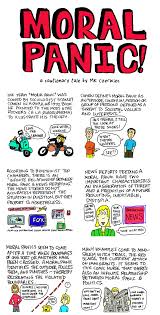
1. What is the fundamental problem with the discourses around children's use of technology?
Tapscott has argued that an entire generation of young people is different to previous generational cohorts because of its experience of networked and digital technologies. He has claimed to identify a generational shift that concludes significant changes in attitudes and approaches to learning. He suggested that it is because of changes in technology that there have been some " inevitable" consequences for learning.
2. What is meant by the term "moral panic"? Link to an image, online article, cartoon, or some other resource that depicts the "moral panic" associated with young people's use of digital technologies.
3. How do you feel about engaging in more "collaborative learning" during your education at Fairmont State?
I feel like we should have more collaborative learning because from my experience I do better with collaborative learning. I like working together with people. I get to know their views on a certain subject but I can also put my input in too. It makes me learn better with like the information I don't understand I can just go to one of my group members and ask.
4. Do you think Universities should move to a more free-market based privation business model? Why?
No because we have a perfectly good business model.
5. According to the author what is wrong with Prenskey's revived position on his definition of "digital native"? Do you agree with this authors criticism of Prenskey's view of the role technology plays in the education of young people?
The move he makes is from a hard of technological determinism, claiming that technology has created the divide between natives and immigrants, to a soft form of determinism in which digital enhancement is necessary for everyone if they are to succeed in the new digital world.
6. What are the characteristics of Millennial? Are you a Millennial?
Recent outcrop of a long historical process and the fusion of the idea of the Net Generation with the idea of Millenials can be seen as cementing this cyclical generational view into the idea of a Net Generation in education. No.
7. Do you think there is such a thing as the " Net Generation"? Why? Why not?
Yes because technically it is the same thing as digital native.
8.What is meant by the term "network individualism"?
A move away from place-to-place interaction towards interactions that are person-to-person in character.
9. How would you feel about Fairmont State discontinuing the use of Blackboard and Webmail to using Gmail and Google tools?
I think Blackboard and Webmail are unreliable because sometimes they may work but others they won't. For example, some teachers don't know how to use Blackboard so the students don't know their grade or if they have assignments. Look at how long Webmail was out and we could not get our mail or anything. So yes I agree we should switch to Gmail and Google Tools.
10. Why does the term "Digital Native" persists despite lack of empirical evidence of age related difference due to rapid increase of digital technologies?
There is a difference between Digital Native and digital technologies. Digital technologies change every day no matter what but really Digital Native does not change.
11. Who societal sector seems to be benefiting the most from the social construction of a "Digital Native" generation?
Universities
12. Which argument about "digital natives" needs to be discarded and which one needs to be explored? Why?
Some work has tried to replace the idea of a Net Generation and digital natives with a new replacement metaphor.
Thursday, October 11, 2012
Double Entry Journal #9
1. Why is inflation less of a concern in the new world economy?
There is less inflation-prone environment created across the globe by the very fluid new world economy with its twin economic and technological revolutions.
2. What is the difference between a negative feedback economy and a positive feedback economy?
Consider the classic cycle of wheat: when prices rise, farmers produce more, consumers buy less, and equilibrium is restored at a lower level of demand. It is limited by short-term supply- and-demand constraints.
3.Give an example of how new technologies can provide developing countries with an opportunity to catch-up with modern economies?
In education, the opportunities are equally tremendous. To give just one example, in Mexico, the Monterrey Tech university has in a few years become one of the world's foremost distance learning systems, with some thirty connected campuses across Latin America offering each student access to the same star professor. In many developing countries, teacher networking over the Internet is leading to better curriculum development and rapid exchanges of best practices.
4.What is one prediction the author made concerning the new economy that appears to be true?
The hub-and-spoke network developed by the U.S. airline industry since deregulation means that 80 percent of U.S. airline industry travel now takes off or lands at the busiest 1 percent of airports. If a problem hits one or a few big hubs, it ripples throughout the network.
5.Why is excessive trust in free-market economies promoted by free-market fundamentalists a cause for concern?
With the central planning model gone for good, more politicians and other players see the market as the solution to all problems, sometime dumping on government while they are at it.
6.Read and link to a website that provides information about regulation and markets. Based on the information provided in the website, what is your position on markets and regulations? Then list two questions you have about markets and regulation.
Market Regulations It is pretty much just markets is stuff you sell or show off and regulations is just rules and i think we need both regulation and markets.
7.What is the cause of the crisis of complexity in the new world economy?
A crisis of complexity is brewing. Human institutions tend to evolve only slowly, in a linear way.
There is less inflation-prone environment created across the globe by the very fluid new world economy with its twin economic and technological revolutions.
2. What is the difference between a negative feedback economy and a positive feedback economy?
Consider the classic cycle of wheat: when prices rise, farmers produce more, consumers buy less, and equilibrium is restored at a lower level of demand. It is limited by short-term supply- and-demand constraints.
3.Give an example of how new technologies can provide developing countries with an opportunity to catch-up with modern economies?
In education, the opportunities are equally tremendous. To give just one example, in Mexico, the Monterrey Tech university has in a few years become one of the world's foremost distance learning systems, with some thirty connected campuses across Latin America offering each student access to the same star professor. In many developing countries, teacher networking over the Internet is leading to better curriculum development and rapid exchanges of best practices.
4.What is one prediction the author made concerning the new economy that appears to be true?
The hub-and-spoke network developed by the U.S. airline industry since deregulation means that 80 percent of U.S. airline industry travel now takes off or lands at the busiest 1 percent of airports. If a problem hits one or a few big hubs, it ripples throughout the network.
5.Why is excessive trust in free-market economies promoted by free-market fundamentalists a cause for concern?
With the central planning model gone for good, more politicians and other players see the market as the solution to all problems, sometime dumping on government while they are at it.
6.Read and link to a website that provides information about regulation and markets. Based on the information provided in the website, what is your position on markets and regulations? Then list two questions you have about markets and regulation.
Market Regulations It is pretty much just markets is stuff you sell or show off and regulations is just rules and i think we need both regulation and markets.
7.What is the cause of the crisis of complexity in the new world economy?
A crisis of complexity is brewing. Human institutions tend to evolve only slowly, in a linear way.
Tuesday, October 9, 2012
Double Entry Journal #8
1. What was the term "Digital Native" meant to be used as?
metaphor for describing the differences that many people observed between the attitudes of younger and older people regarding digital technology.
2. According to author what are the characteristics associated with Digital Natives?
why so many adults in developed countries felt, around the turn of the century "at sea" when confronted by new digital technologies. The metaphor implied was because their children were born into the age when these technologies were around from their birth, whereas their parents were not. That is why the metaphor was picked up so quickly and spread so widely.
3. Do you consider yourself a Digital Native?
yes
4. What is Digital Wisdom?
Twofold concept referring both to wisdom arising from the use of digital technology to access cognitive power beyond our innate capacity and to wisdom in the prudent use of technology to enhance our capabilities.
5. How does the author define "wisdom"?
Can be used to make us not just smarter but truly wiser.
6. How can technology enhance our Wisdom? Give three examples from the chapter?
Wisdom seekers in the future will benefit from unprecedented, instant access to ongoing worldwide discussions, all of recorded history, everything ever written, massive libraries of case studies and collected data, and highly realistic simulated experiences equivalent to years or even centuries of actual experience.
7. What concerns did Socrates have about the technology of writing?
Writing would diminish our memories but was shortsighted in that concern.
8. How can teachers practices Digital Wisdom?
Teachers could put more technology use in their school schedule.
9. The author states that he is "...opposed to those who claim the unenhanced mind and unaided thinking are somehow superior to the enhanced mind." Are you? Why or why not?
Yes because I believe our mind is always increasing and each and every day we unaid our mind and that is superior to the enhanced mind.
Quote:
He argues that the new technologies associated with contemporary popular culture, from video games to the internet to television and film, make far more cognitive demands on us than did past forms, thus increasing our capabilities in a wide variety of cognitive tasks. (Steven Johnson)
 Discussion:
I agree with this quote because video games, internet, television, and etc makes far more cognitive demands on us than past forms. When we play a video game we have to think of a strategy to kill the opponent for example. For the internet, you have to think of key words to type in the search engine and you have to find a reliable source. With making a film, you have to figure out what the audience is interested in to the film can become popular. But in the past, they did not have such high tech technology.
Citations:
Thomas, Michael. "Deconstructing Digital Natives."
Kenuam, Amanda."10 Ways To Use Skype in the Classroom."
metaphor for describing the differences that many people observed between the attitudes of younger and older people regarding digital technology.
2. According to author what are the characteristics associated with Digital Natives?
why so many adults in developed countries felt, around the turn of the century "at sea" when confronted by new digital technologies. The metaphor implied was because their children were born into the age when these technologies were around from their birth, whereas their parents were not. That is why the metaphor was picked up so quickly and spread so widely.
3. Do you consider yourself a Digital Native?
yes
4. What is Digital Wisdom?
Twofold concept referring both to wisdom arising from the use of digital technology to access cognitive power beyond our innate capacity and to wisdom in the prudent use of technology to enhance our capabilities.
5. How does the author define "wisdom"?
Can be used to make us not just smarter but truly wiser.
6. How can technology enhance our Wisdom? Give three examples from the chapter?
Wisdom seekers in the future will benefit from unprecedented, instant access to ongoing worldwide discussions, all of recorded history, everything ever written, massive libraries of case studies and collected data, and highly realistic simulated experiences equivalent to years or even centuries of actual experience.
7. What concerns did Socrates have about the technology of writing?
Writing would diminish our memories but was shortsighted in that concern.
8. How can teachers practices Digital Wisdom?
Teachers could put more technology use in their school schedule.
9. The author states that he is "...opposed to those who claim the unenhanced mind and unaided thinking are somehow superior to the enhanced mind." Are you? Why or why not?
Yes because I believe our mind is always increasing and each and every day we unaid our mind and that is superior to the enhanced mind.
Quote:
He argues that the new technologies associated with contemporary popular culture, from video games to the internet to television and film, make far more cognitive demands on us than did past forms, thus increasing our capabilities in a wide variety of cognitive tasks. (Steven Johnson)
Discussion:I agree with this quote because video games, internet, television, and etc makes far more cognitive demands on us than past forms. When we play a video game we have to think of a strategy to kill the opponent for example. For the internet, you have to think of key words to type in the search engine and you have to find a reliable source. With making a film, you have to figure out what the audience is interested in to the film can become popular. But in the past, they did not have such high tech technology.
Citations:
Thomas, Michael. "Deconstructing Digital Natives."
Kenuam, Amanda."10 Ways To Use Skype in the Classroom."
Subscribe to:
Posts (Atom)