
Moral Panic is a term that has arisen to describe conditions in which and identified group in society is portrayed as a threat to social values and norms. 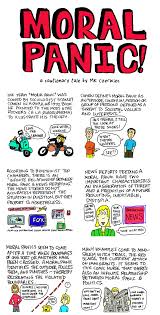
1. What is the fundamental problem with the discourses around children's use of technology?
Tapscott has argued that an entire generation of young people is different to previous generational cohorts because of its experience of networked and digital technologies. He has claimed to identify a generational shift that concludes significant changes in attitudes and approaches to learning. He suggested that it is because of changes in technology that there have been some " inevitable" consequences for learning.
2. What is meant by the term "moral panic"? Link to an image, online article, cartoon, or some other resource that depicts the "moral panic" associated with young people's use of digital technologies.
3. How do you feel about engaging in more "collaborative learning" during your education at Fairmont State?
I feel like we should have more collaborative learning because from my experience I do better with collaborative learning. I like working together with people. I get to know their views on a certain subject but I can also put my input in too. It makes me learn better with like the information I don't understand I can just go to one of my group members and ask.
4. Do you think Universities should move to a more free-market based privation business model? Why?
No because we have a perfectly good business model.
5. According to the author what is wrong with Prenskey's revived position on his definition of "digital native"? Do you agree with this authors criticism of Prenskey's view of the role technology plays in the education of young people?
The move he makes is from a hard of technological determinism, claiming that technology has created the divide between natives and immigrants, to a soft form of determinism in which digital enhancement is necessary for everyone if they are to succeed in the new digital world.
6. What are the characteristics of Millennial? Are you a Millennial?
Recent outcrop of a long historical process and the fusion of the idea of the Net Generation with the idea of Millenials can be seen as cementing this cyclical generational view into the idea of a Net Generation in education. No.
7. Do you think there is such a thing as the " Net Generation"? Why? Why not?
Yes because technically it is the same thing as digital native.
8.What is meant by the term "network individualism"?
A move away from place-to-place interaction towards interactions that are person-to-person in character.
9. How would you feel about Fairmont State discontinuing the use of Blackboard and Webmail to using Gmail and Google tools?
I think Blackboard and Webmail are unreliable because sometimes they may work but others they won't. For example, some teachers don't know how to use Blackboard so the students don't know their grade or if they have assignments. Look at how long Webmail was out and we could not get our mail or anything. So yes I agree we should switch to Gmail and Google Tools.
10. Why does the term "Digital Native" persists despite lack of empirical evidence of age related difference due to rapid increase of digital technologies?
There is a difference between Digital Native and digital technologies. Digital technologies change every day no matter what but really Digital Native does not change.
11. Who societal sector seems to be benefiting the most from the social construction of a "Digital Native" generation?
Universities
12. Which argument about "digital natives" needs to be discarded and which one needs to be explored? Why?
Some work has tried to replace the idea of a Net Generation and digital natives with a new replacement metaphor.

Good understanding of the arguments for and against the term "digital Natives".
ReplyDelete